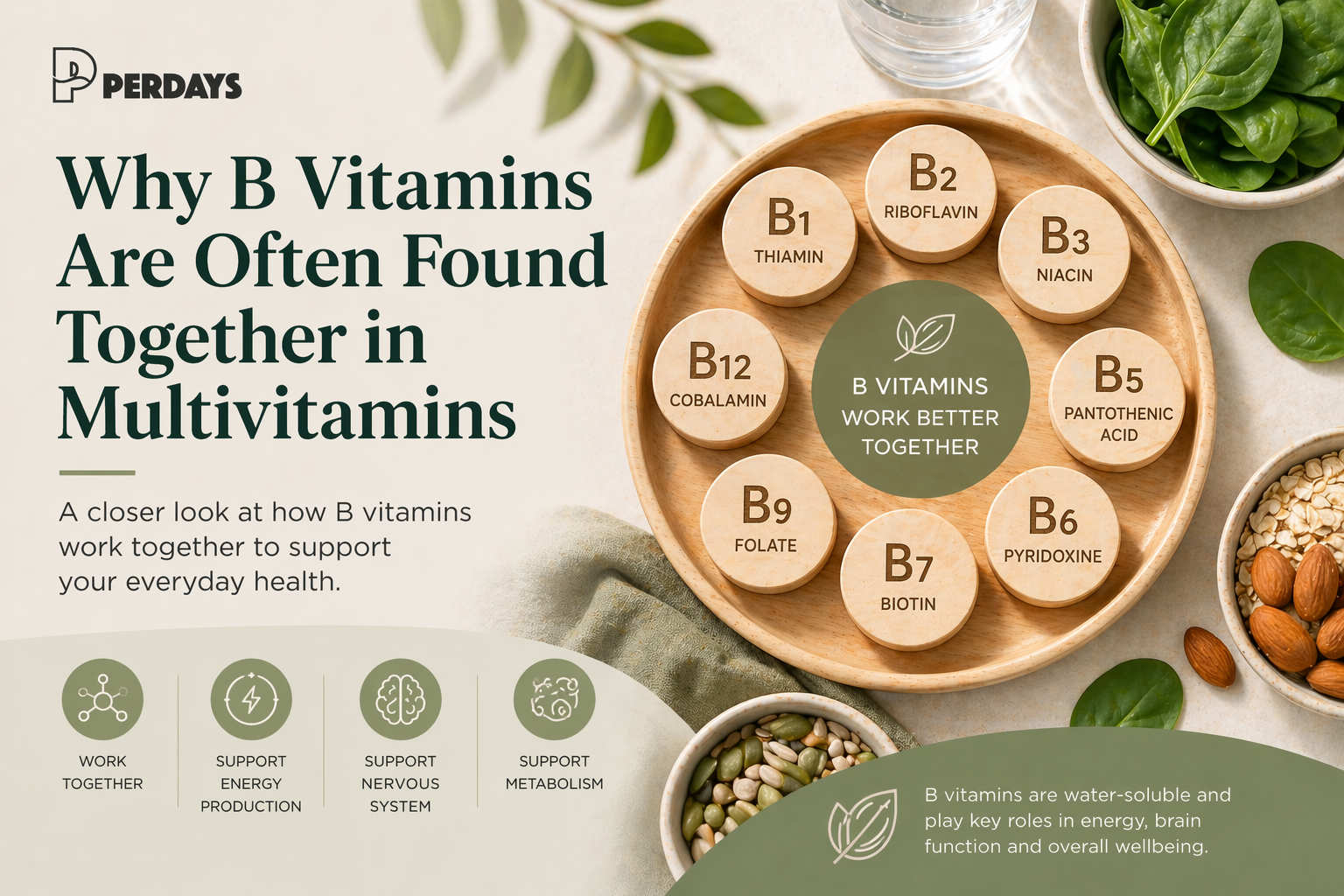
B vitamins are commonly discussed as a group in everyday nutrition and are often included together in multivitamin products. In B vitamins nutrition, these vitamins are typically described collectively due to their presence in a range of foods and their inclusion in multinutrient products. Understanding how B vitamins are grouped and how they appear in multivitamin formulations can help clarify how they are presented in both food and supplement contexts.
What Are B Vitamins?
B vitamins refer to a group of water-soluble vitamins that are commonly discussed together in nutrition. This group includes vitamins such as B1, B2, B3, B5, B6, B7, B9, and B12. In B vitamins nutrition, they are often referenced collectively rather than individually, particularly in general dietary discussions.
Why Are B Vitamins Grouped?
B vitamins are grouped because they are commonly found in similar food sources and are often discussed as a group in nutrition education. In a multivitamin formulation, these vitamins are frequently included together to provide a combination of nutrients within a single product. Their grouping reflects how they are commonly presented in both foods and supplements.
B Vitamins and General Nutrition
In B vitamins nutrition, these vitamins are often included as part of overall dietary intake. They are present in a variety of foods and are commonly referenced in discussions about balanced eating patterns. Their inclusion in nutrition discussions is typically broad and varies depending on dietary habits and food choices.
B Vitamins in Foods
B vitamins occur naturally in a wide range of foods and are often present together rather than individually. This is one reason they are frequently discussed as a group in nutrition.
Foods That Commonly Contain B Vitamins
Foods that commonly contain B vitamins include:
-
Whole grains
-
Legumes
-
Meat and poultry
-
Dairy products
-
Vegetables
These foods are often referenced in B vitamin nutrition as part of everyday dietary patterns.
Why Multivitamins Often Include Multiple B Vitamins
Multivitamins often include multiple B vitamins as part of their overall formulation. In a multivitamin formulation, combining several B vitamins allows products to include a range of nutrients that are commonly discussed together. This approach reflects how B vitamins are grouped in nutrition and how they appear in many multinutrient products, including multivitamins commonly used in preconception nutrition.
B Complex vs Individual B Vitamin Supplements
A B-complex supplement generally contains several B vitamins in one formulation, while individual B vitamin supplements contain only one specific vitamin. In multivitamin formulation, B-complex combinations are often used to represent the group of B vitamins within a single product. The choice between single and combined formulations may vary depending on individual preferences and dietary considerations.
Can Nutrient Needs for B Vitamins Differ Between Individuals?
Nutrient intake and dietary patterns can vary between individuals. In B vitamin nutrition, factors such as food preferences, lifestyle, and cultural dietary habits may influence how B vitamins are included in a diet. As a result, nutrition discussions are generally presented in a flexible and non-prescriptive way.
Frequently Asked Questions About B Vitamins in Multivitamins
Why are B vitamins often found together in multivitamins?
B vitamins are often found together in multivitamins because they are commonly discussed as a group in nutrition and are frequently present together in foods. A multivitamin formulation, including multiple B vitamins, reflects how they are naturally grouped in dietary patterns and how they are typically described in nutrition education.
What is a B-complex vitamin?
A B-complex vitamin is a supplement that contains several B vitamins combined in a single formulation. Instead of providing one specific vitamin, it includes multiple B vitamins that are commonly grouped in B vitamin nutrition.
Are all B vitamins the same?
No, B vitamins are not the same. They are a group of different vitamins, each with its own name and characteristics, but they are often discussed together in nutrition because they are commonly found in similar foods and frequently included together in supplements.
Do foods naturally contain more than one B vitamin?
Yes, many foods naturally contain more than one B vitamin. Foods such as grains, legumes, and animal-based products often include several B vitamins, which is one reason they are commonly grouped in nutrition discussions.
Why do supplement labels list several B vitamins separately?
Supplement labels list each B vitamin separately to show the individual nutrients included in the formulation. This helps identify the specific vitamins present and reflects how each B vitamin is recognised as a distinct nutrient.
Is a B-complex the same as a multivitamin?
No, a B-complex is not the same as a multivitamin. A B-complex contains only B vitamins, while a multivitamin typically includes a broader range of vitamins and minerals beyond the B vitamin group.